
Direct contact to law firm
Berlin +49 30 88 03 59 0
Poznań / Warszawa +48 61 85 82 55 0
Berlin berlin@vonzanthier.com
Poznań / Warszawa poznan@vonzanthier.com
VON ZANTHIER & DACHOWSKI
Current articles
 

Investment and commercial law Entrepreneur - Time Limits on Claims Can Cost You – Stay Alert!

If you use transport services or run a business in the transport sector, remember that the limitation periods for claims in this industry are significantly shorter than the general limitation periods provided for in the Civil Code (3 or 6 years).

Missing these deadlines can prevent you from successfully pursuing your receivables! If your claim becomes time-barred, your counterparty can effectively raise the statute of limitations before the court, which usually results in the dismissal of your case and the loss of a real possibility to recover your receivables.

That is why vigilance and quick action are especially important in the transport industry.

Discussion of statute of limitations in transport-related cases requires particular attention to the proper legal provisions governing the specific transport service. The relevant regulations in this area are divided into:

Domestic cases – governed by the Polish Transport Law Act (Prawo przewozowe),

International cases – regulated by the Convention on the Contract for the International Carriage of Goods by Road (CMR).

Below, we present a summary of the most important issues related to the statute of limitations for claims in both domestic and international transport.
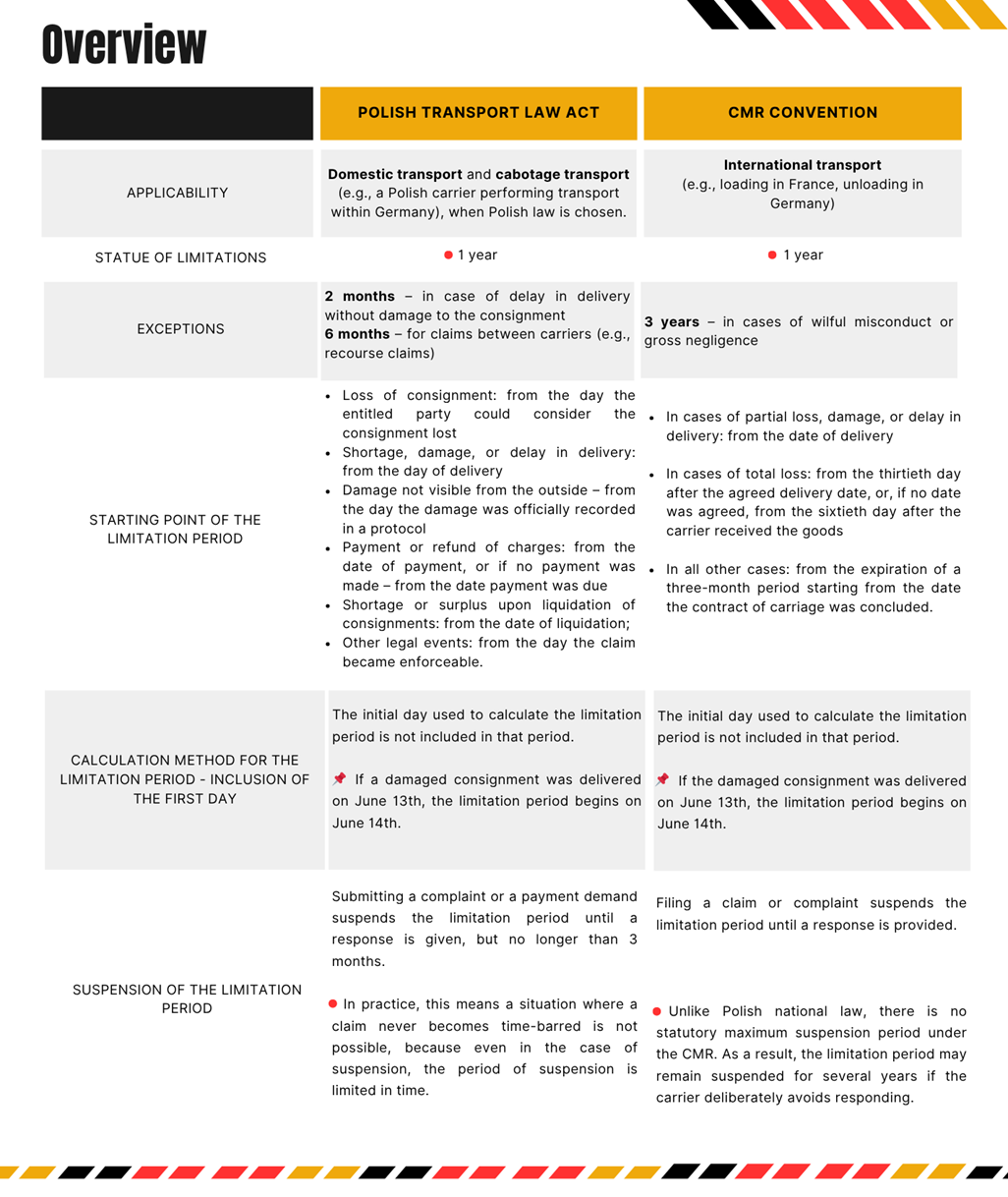
Summary

• Considering the exceptionally short periods allowed for pursuing claims, we emphasize how important it is to act promptly to recover receivables;

• The start of the limitation period depends on the type of event involved;

• Filing a complaint suspends the running of the limitation period, but the conditions for suspension differ under domestic and international law;

• We recommend ongoing monitoring of potential claims and using professional legal support, as only prompt action can help minimize the risk of claims becoming time-barred.


Article published on
26 June 2025

Keywords in this article

Share this article

You may also be interested in these articles:

current, Company law, company formation, restructuring
12.02.2026

Acquisition vs. Setting up a Company: Which is more profitable for a safe entry into the Polish market?

The stable economic situation increasingly encourages foreign investors to enter the Polish market. Strategic investors must choose between establishing a new company in Poland or acquiring an existing one. This article explores the benefits of acquiring an active company and outlines the formal requirements of this procedure under the Polish Commercial Companies Code (PL KSH).

Read article
current, VAT Compliance
12.02.2026

Registration of foreign companies for VAT in Poland - guide for companies from Germany and the EU

Do you want to sell products in Poland or across the European Union? If you operate a company from Germany or another EU country and plan to sell goods or services in Poland, you need to be aware of your VAT obligations. This article provides a comprehensive guide to registering foreign companies for VAT in Poland, including procedures, required documents, and tax responsibilities.

Read article
current, Commercial law
11.02.2026

Qualified electronic signature vs Trusted Profile - what’s the difference and which one should you choose?

Electronic document signing has become a daily practice in limited liability companies, yet the concept of an “electronic signature” still often leads to misunderstandings. In this article, we explain the differences between a qualified electronic signature and a trusted profile, and indicate which solution is appropriate and in which situations.

Read article