Direct contact to law firm
Berlin +49 30 88 03 59 0
Poznań / Warszawa +48 61 85 82 55 0
Berlin berlin@vonzanthier.com
Poznań / Warszawa poznan@vonzanthier.com
VON ZANTHIER & DACHOWSKI
Current articles
 

Investment and commercial law The most common mistakes made during debt collection and how to avoid them

The most common mistakes made during debt collection and how to avoid them

The article highlights the most common mistakes that occur during the debt collection process and recommends specific actions to avoid them and recover funds more effectively. Additionally, it offers practical advice to streamline collection procedures and reduce the risk of financial losses.

The most common mistakes made during debt collection and how to avoid them

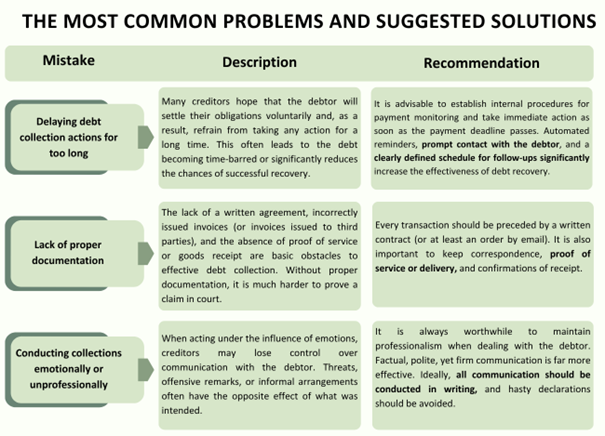
Debt collection is an integral part of running a business. In practice, however, many companies and individuals make mistakes that not only prolong the process of recovering funds but may also result in the permanent loss of the claim.

Below you will find an overview of the most common mistakes made in the debt collection process, as well as practical tips on how to avoid them.
Summary

Avoiding the above mistakes not only allows for more efficient recovery of outstanding debts but also protects a company or individual against financial losses. It is important to remain vigilant, act quickly and professionally, and document every transaction. This way, the debt collection process will proceed more smoothly and with a greater chance of success.


You may also be interested in these articles:

current, Investment and commercial law
06.08.2026

SP. Z O.O. EXPLAINED – MEANING, LEGAL FORM, DIFFERENCES FROM GMBH

A limited liability company (sp. z o.o.) is a business form that continues to enjoy enduring popularity in Poland among both new and experienced entrepreneurs. Thanks to the advantageous combination of limited liability for shareholders and relatively low entry barriers, a sp. z o.o. offers an attractive alternative to other types of companies and sole proprietorships.

Read article
current, Labour law and HR
06.08.2026

6 months to implement new obligations. Which employers will need a new internal policy?

The amendment to the Labour Code introduces a comprehensive obligation for employers with at least 10 employees to regulate how they prevent mobbing, discrimination and violations of personal rights. Employers will have 6 months from the entry into force of the act to adapt their internal documentation.

Read article
current, Investments in renewable energies
20.07.2026

Energy mix in Poland and Germany: differences and opportunities for investors

Comparing the energy mix of Poland and Germany helps investors realistically assess emission intensity, price risk and grid connection realities, and to design an appropriate ESG and energy procurement strategy. A concise map of the differences and similarities increases the robustness of business models and enables targeted use of local opportunities.

Read article